
the humanity matrix
how humans create in the social universe

out of body in Brazil
i recently got back from a week-long trip to Brazil, it was my first time in South America, and, surprisingly, my first time in a nation (outside of the US) whose very foundations were shaped by the transatlantic slave trade. what struck me immediately was how familiar it felt: Blackness in America & Blackness in Brazil, though born from different histories, seemed to mirror each other. both being the result of complex ethnics mixes, Indigenous, African, & European, yet both having produced cultures so vibrant they’ve become global symbols.
i went hoping to understand something about myself, and about what African Americans and Afro-Brazilians might learn from one another, a diasporic lesson. in many ways, being there felt like looking into a reflection, it gave shape to the collective histories & politics that create the idea of Blackness.
this trip enabled me step back and see another version of Blackness, not the human-identity one, but the one built by social process, the version that is a story of becoming. in Rio, i could suddenly see the edges, curves, and political dimensions of Blackness with a clarity i hadn’t before. and as i observed it, a shape emerged — a geometry explaining the social dimensions that makes something “Black”.
it made me think about our power as humans to create objects, not just physical objects, but conceptual ones — like Blackness. thinking broadly, just as the universe generates objects like planets and galaxies, humanity too creates. but the objects we create are determined by the forces that shape us: history, power, recognition, erasure, culture, resistance, imagination. think of social objects like disability, class, migration, citizenship, nationhood, all of this concepts are highly architected, emerging across relational time, and collectively built & maintained.
so, Blackness, in this sense, isn’t just an identity, it is an object of humanity, a structure formed in social space, shaped by centuries of pressure and possibility. and like any object in the universe, it has dimensions that can be mapped.
objects of humanity
i want to introduce a framework i call objects of humanity. this framework is a way to map the emergence and patterns of human life. objects of humanity are not identities or people. they are structures, or emergent shapes created when groups of humans interact with history, power, culture, and time.
think back to some social objects like:
Blackness
Indigeneity
nationhood
citizenship
womanhood
all of these social structures can be plotted in social space along three primary axes:
x-axis – cultural presence (width): measures the density and visibility of life and creative expression. this can come in the form of music, ritual, aesthetics, food, and language.
y-axis – political recognition (height): measures access to authorship, sovereignty, legal/political power, and historical acknowledgment.
z-axis –acknowledged humanity (depth): measures dignity, social inclusion, and recognition as fully human.
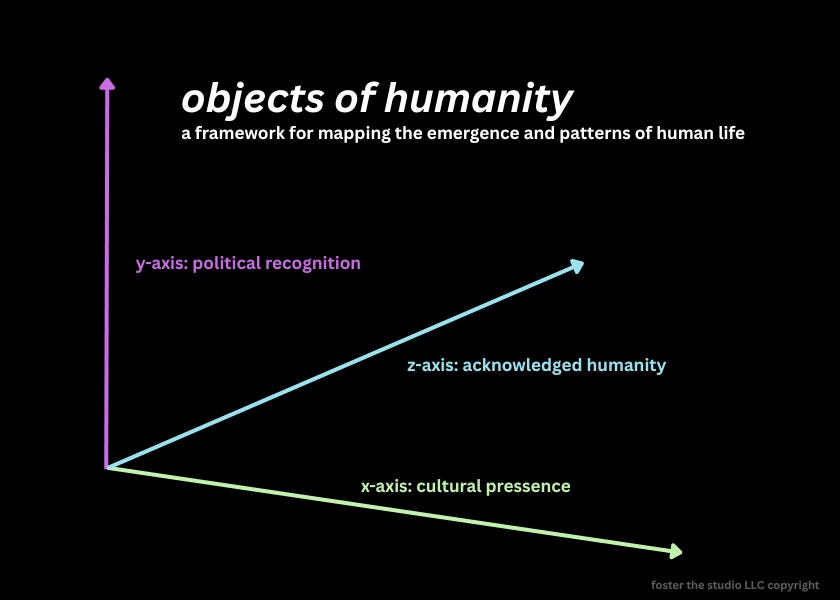
i choose these three to be the primary axes of social space because they are the backbone of how humans create meaning and life — it’s what makes humanity, humanity. culture being our collective expression, politics being how human interact with power and legitimacy, and humanity as moral recognition. together every object in social space is shaped by:
what we express
what we are allowed
& what is acknowledged
together this creates the humanity matrix.
so much of the practice of foster the studio, is studying to architecture of meaning, so i find this framework extremely helpful, as it helps us see structural patterns within human life instead of isolated experiences (as historians would want it to be told). it turns qualitative experience into something we can observe and analyze, without reducing people to statistics or stereotypes. it captures emergent patterns over time: creation, erasure, resilience. and ultimately, it gives us tools to rethink and re-architect our collective futures.
mapping Blackness in Brazil
let’s go back to Blackness as an object of humanity. seeing Blackness in Brazil was a gateway to seeing Blackness as a social object. the familiarity i felt in Brazil was met with an equal amount of discomfort. i could see the rules of Blackness clearly in way i’d never been able to see in America, it was like looking at a clone of yourself, seeing yourself in third person.
Blackness in Brazil isn’t the exact same object of Blackness in America, but both have distinct shapes.
the x-axis (cultural presence): fully extended. music, ritual, food, color, and everyday life saturate streets and ceremonies.
the y-axis (political recognition): compressed. despite cultural abundance, Black Brazilians are largely absent from the story of the nation’s creation, denied sovereignty and historical acknowledgment.
z-axis (acknowledged humanity): shallow. Black bodies are visible everywhere, majority Black country, but their humanity is often conditional, recognized only when convenient or superficial.
the result is a hollow object: wide with culture, short in authority, and shallow in recognized humanity. its surface is radiant, full of sound, color, ritual, brilliance — culture, yet its core, the center where authorship, power, and full acknowledgment should reside, remains largely empty.
this hollowness is why we can distinguish being a child of the African diaspora from being “Black.” Blackness, as we inherit it in the Americas, is not a neutral identity. it is a social construction, heavily and conveniently engineered — that functions as a denial of humanity, authorship, and sovereignty. it is a social object imposed onto people, not an essence contained within them. the body and the conceptual object are not the same.
across the Americas, particularly in nations shaped through the transatlantic slave trade, this hollow geometry reappears. in the United States, too, Blackness is coupled with the systematic withholding of dignity, safety, and recognition. and yet this object endures, holding itself together, expanding culturally even as political and human recognition remain constricted.
into the fourth dimension: memory-time
let’s go back to physics class briefly. in physics, space and time are not separate. they form a single fabric called spacetime, which bends and warps in the presence of mass and energy. this curvature shapes how objects move, relate, and emerge. gravity, Einstein teaches us, is not a pull at all but a distortion, its spacetime responding to pressure.
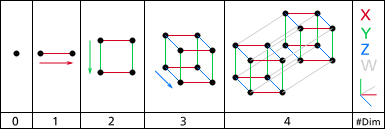
this idea maps directly onto the humanity matrix.
humans too are bound by time, but not in the simple, chronological sense we learn in history class. the duration of humanhood has never been linear. it is shaped by rupture, displacement, invention, forgetting, and return. across civilizations, time is experienced through repetition, adaptation, inheritance, improvisation, and reconstitution, a relational process more than a temporal sequence.
Einstein’s theory of relativity teaches that gravity is not a force but a consequence of mass and energy bending spacetime. interaction creates curvature. pressure creates shape.
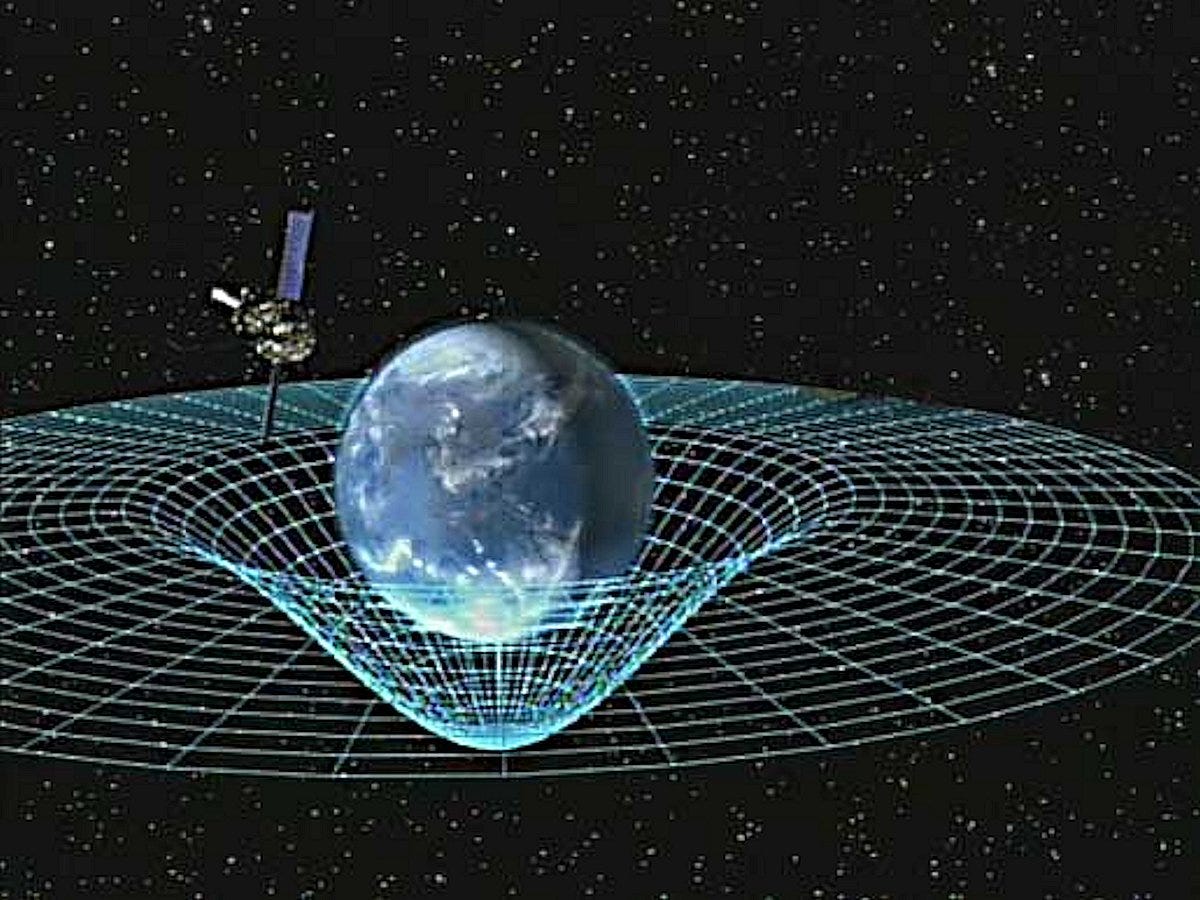
this is where the fourth dimension enters the Humanity Matrix: memory-time. think of this axis as the dimension of becoming — the processes set into motion by culture, politics, pressure, imagination, and acknowledgment. every human object becomes something through accumulation: through adaptation, inheritance, trauma, resistance, erasure, and recovery.
like spacetime in physics, memory-time is nonlinear. it can bend. it can be stretched. it can collapse and re-expand. it can hold contradiction.
and just as physical objects cannot exist outside spacetime, objects of humanity cannot exist outside duration and memory.
when we plot Blackness into this fourth dimension, its three-dimensional hollowness becomes dynamic rather than static. the “empty” interior becomes a site of movement, revealing patterns of improvisation, community, & ritual. this gives the object form, resilience, and emergent life, not by filling the hollow shape, but by circulating within it.
in the case of Blackness we can add another layer — diasporic memory-time. then we can finally see what holds Blackness together: the improvisational practices, rituals, collectives, and cultural inventions that allow this object to bend without breaking, to survive distortion, and still create meaning across generations.
the importance of memory-time
i believe this fourth dimension is a crucial key to empowering us to see how humans navigate and manipulate their social environments over space and time. memory time gives us the fullest picture of what an object is, how it moves, and how it persists.
space-time in physics curves around massive objects; in the diaspora, time “curves” around trauma, colonialism, and systemic oppression. Blackness adapts, improvises, and emerges in new forms, just as space-time produces gravity wells and warped geometries. it shows how culture, identity, and humanity move, survive, and emerge across generations, even under constraint.
through this lens, we can ask new questions on humanity and humanhood.
what kind of objects have been allowed to form?
which dimensions have been inflated, compressed, or denied?
what persists over time despite distortion?
this framework expands our thinking beyond moral binaries, and gives us structural clarity. we are no longer asking whether something is human, but how humanity is allowed to take shape, and which forces shape its form. it gives us a tool to re-architect the objects we create with intentionality, revealing patterns that allow us to emerge, endure, and create.
i am so grateful for Brazil to allowing me to see outside of myself, and author this framework. as empowering it is for us to know that we can humans are creators, it is equally important to study how we create, the invisible forces that distort these creations, it gives a fuller picture to the human universe.
i want to close with some photos from some patterns i observed in Brazil. each pattern revealed a structure to how Brazil was thinking & creating itself in this modern age.
i hope you enjoy :)


