

as an artist-researcher, i’m drawn to human systems — how they’re created, how they evolve, and how they can be translated from invisible to visible. so much of the human experience is unsaid, governed by silent structures we rarely notice or name. to name is to know, to locate, to transform, it is a vehicle to agency, something we are all seemingly in a deficit of. without naming, we remain at the mercy of what we cannot see.
much of foster the studio is dedicated to making the invisible visible. much of our human struggle lies not only in what we don’t know, but in our relationship to the unknown — our agency is the true cost. my practice creates visual frameworks that render these hidden systems perceptible — diagrams of emotion, behavior, and power that help us see the architectures shaping our everyday lives.
art is a democratic translator, it does need a shared vocabulary, it communicates across literacy, culture, and even time; often capturing the metaphysical system or expression the artist trying to capture — this is the invisible humanness. its why we’re so moved by great art — it is an interface between the known and the unknown.
this excites the scientist in me, how do visual works reveal human systems, what power do we gain by documenting their architecture, and what might change once we can finally see them?
the method
translate —> transcribe —> render —> and finally, reflect.
together this creates a method of understanding,
(1) human expression translated into perceptible form (the art)
(2) transcribing the art into a system that can be structured (naming & describing human system/expression)
(3) rendering that system visually into a pattern that is democratically understood (visual frameworks)
(4) reflecting on our relationship to the system in community (our relationship)
last month i tested this method of understanding in action: VIRTUAL MACHINES, a collaborative salon based project at Lore Bookstore in Leimert Park. the project activated my VIRTUAL MACHINES visual framework, inviting participants to see, reflect on, and express the systems that subconsciously shape their lives, and further demonstrating that these frameworks are not just theoretical, but tools for lived awareness & transformation of our collective FUTURES.
the visual framework: VIRTUAL MACHINES
framework for human agency in society under constraint
VIRTUAL MACHINES is a visual framework i developed to understand my own loss of agency. i believe that agency is one of the most important tools we have in this human experience — it quite literally determines our will to act, and without action we remain close minded, unmotivated, squandering our divine purpose.
this past year has felt like agency has been robbed from many Americans. especially in the city of Los Angeles, it has been a turbulent year to say the least. i created this framework to help give hope to a city that was trapped in a cycle of grief & despair.
the framework is as follows:
a virtual machine describes a a system with set boundaries & rules, however it maintains varying degrees of autonomy, running multiple processes & possibilities. sounds a bit like the individual’s relationship with society right? individual life under the constraint of societal norms & rules .
however like any technological system, its code can be re-written. VIRTUAL MACHINES says that radical self expression is the way we re-write our relationship to the rules & norms that constrain us. it says that radical SELF EXPRESSION is our vehicle to authenticity, and further that authenticity allows us to be less bound to the constraints of our oppressors.
mirroring the system dynamics of a traditional VIRTUAL MACHINE, it names four actions (the human mechanics of expression) we can exercise to find our most authentic selves:
EXPAND: test identities, experiment with aesthetics, language, and futures.
PRESERVE: set boundaries, craft survival strategies, safeguard life & your voice.
PROTECT: defend your & the collective’s dignity & authenticity against systems that suppress & erase.
EXPLORE: push beyond expected boundaries, stretch into possibility, & grow through connection.

the result
the VIRTUAL MACHINE analogy is compelling because it so anti-human. it begs the questions, what can we learn from something we ourselves have created (technology), as opposed to let me learn from the natural world and then create from those learnings. personally, i find it to be a fantastic simulator for how we as humans can equally grasp our past and future, thereby focusing on this effervescent present moment — the only real moment in which our authentic self exists.
and this is exactly how we activated the present being — a key pillar of the salon was to interact with the IDEA WALL. the IDEA WALL had several prompts to activate the participants of the salon.
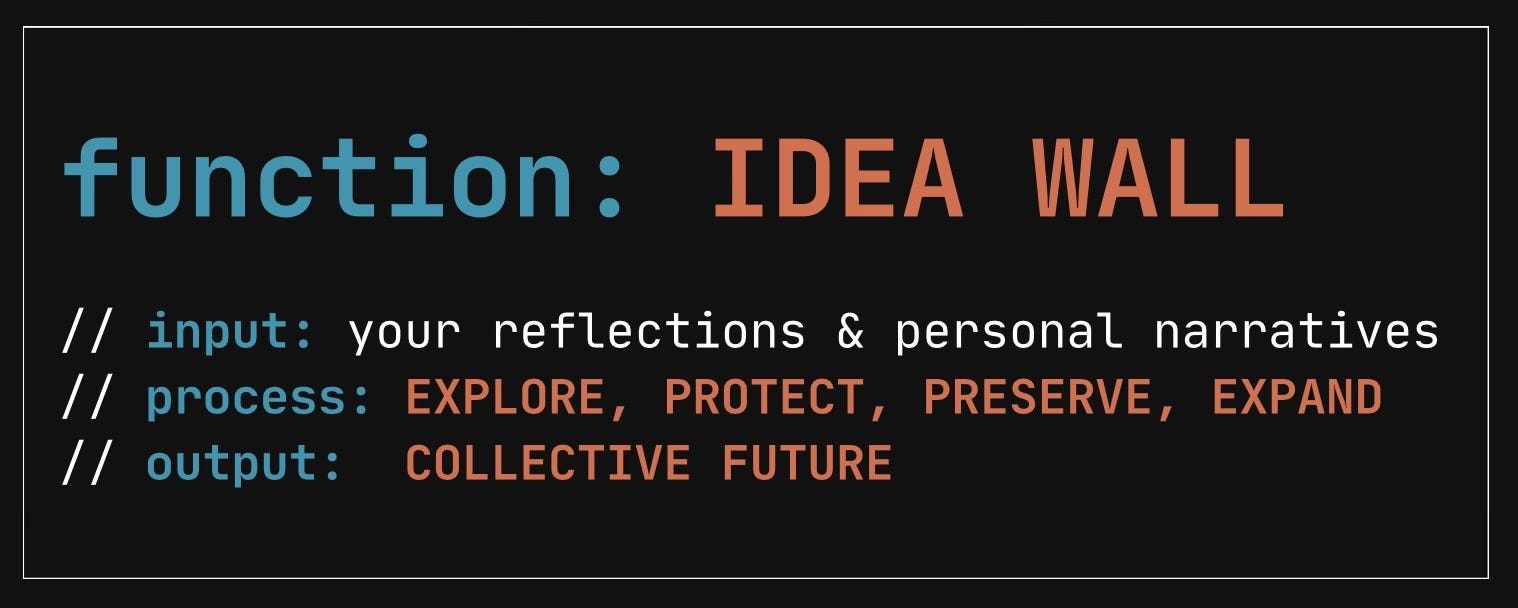
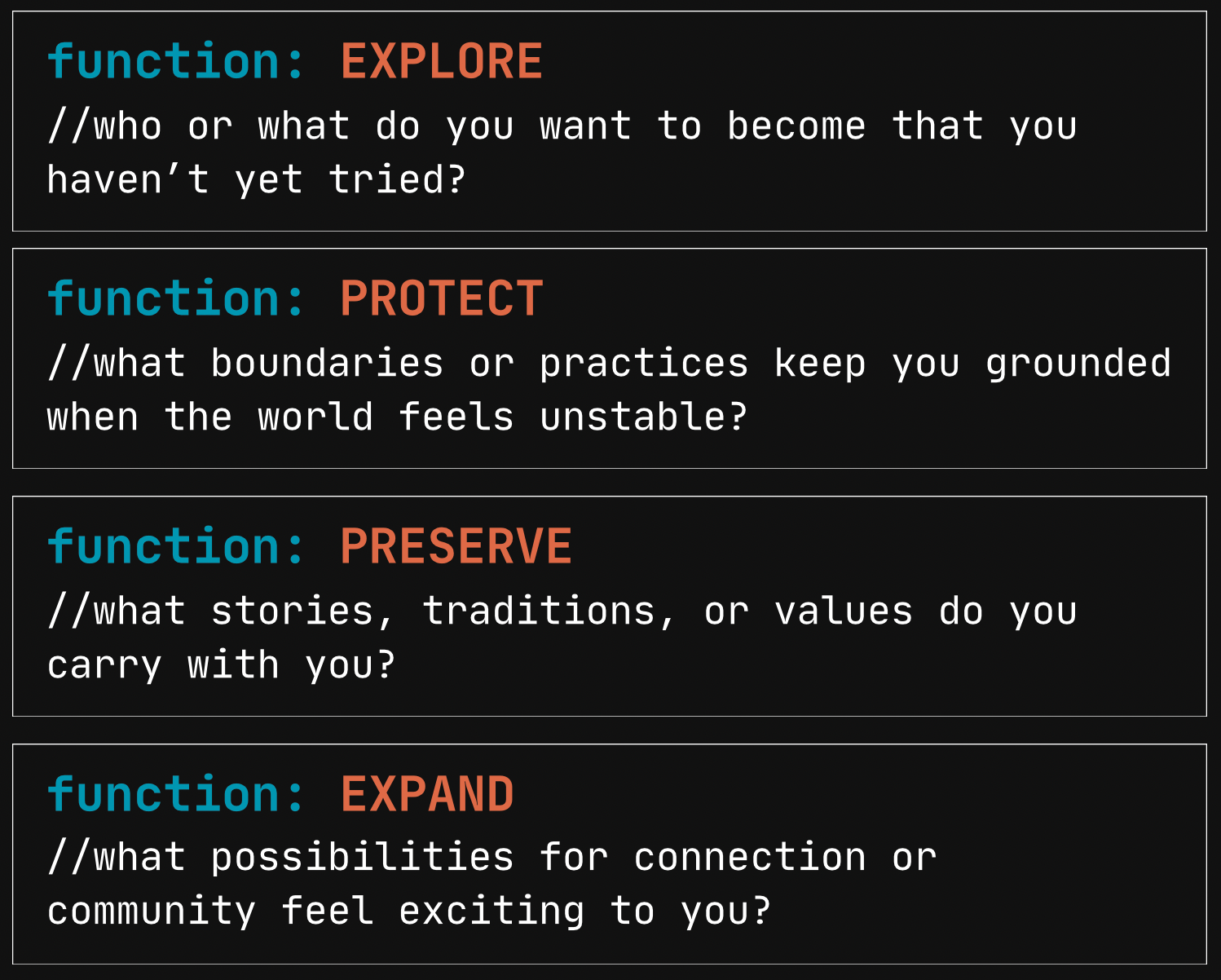
salon participants were asked to write responses to these questions on sticky notes. below is a visual of how the idea wall was presented & the responses.
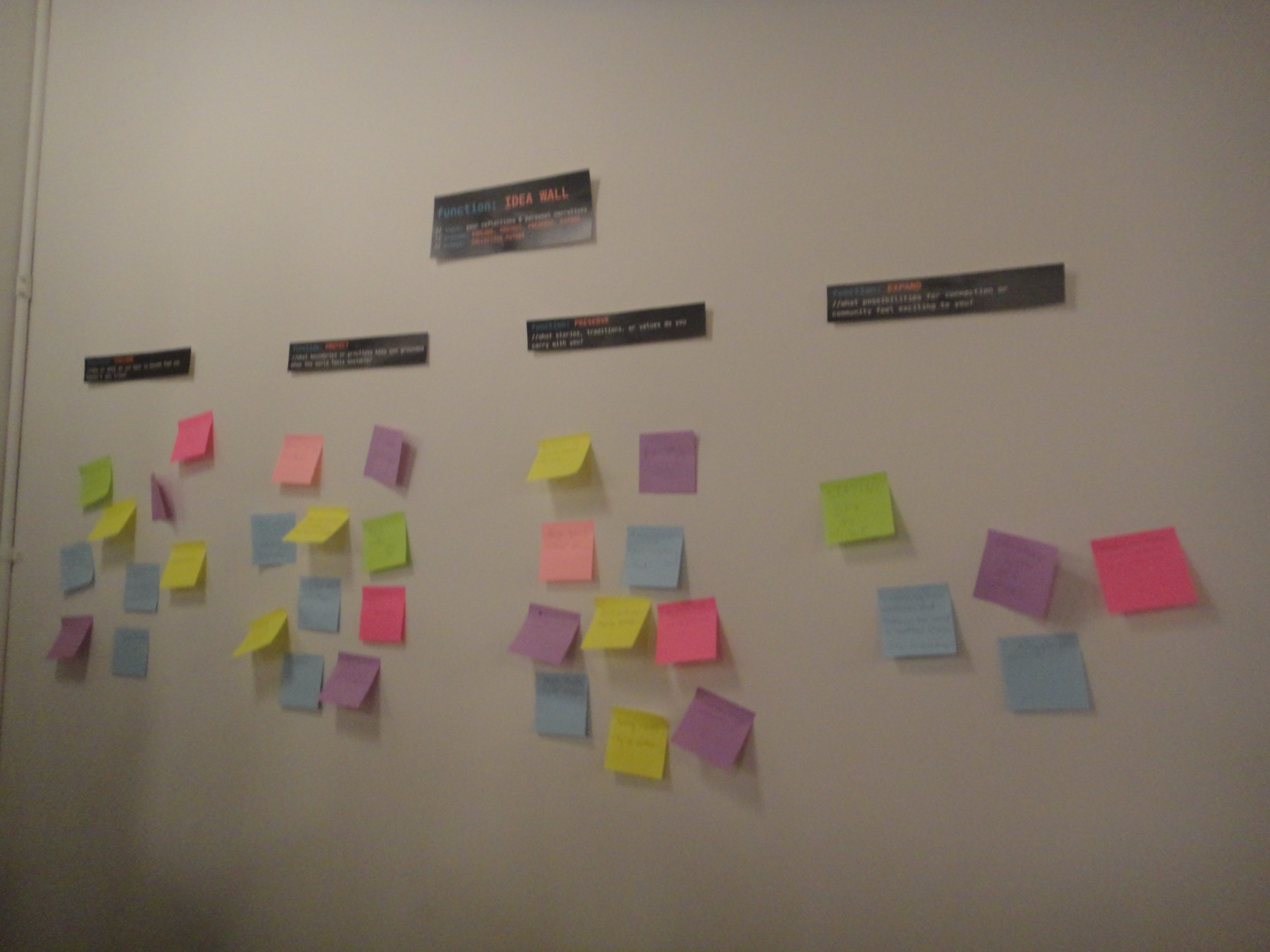


the VIRTUAL MACHINES salon demonstrated the power of visual frameworks to activate self-reflection, dialogue, and insight. from participant interactions, several key patterns emerged:
ideas are abundant, but context activates them. the salon attracted participants who came with rich imaginations and strong ambitions to explore their selfhood. yet (much like any social space in LA), it took some massaging. these ideas only became tangible when given a structured & safe space to articulate and share them. the framework provided both the visual language and the permission to explore identity, creativity, and agency.
intimate discussion catalyzes exchange. personal stories and reflections, once shared, become communal tools (more on communal tools later). participants’ unique experiences, which are so often invisible to others and even themselves were transformed into a shared vocabulary for understanding how human expression & being can exist in the world. something as simple as a telling a story about your daily walk, can ignite a room to begin expressing. this process underscores the role of storytelling in naming, cataloging, and ultimately reshaping the systems that seem to govern our lives.
frameworks stimulate reflection. self-reflection emerged as a chain reaction, ignited by the VIRTUAL MACHINES prompts and the process diagram. the salon illustrated that frameworks are not merely academic or theoretical; they function as operational tools for understanding human systems, making visible what is often subconscious. and particularly they are valuable in artistic environments as they democratize the expression being channeled, making it digestible and applicable to everyone in the room.
authenticity is dynamic. never, at any given point in time do we know ourselves fully, and that is a beautiful thing. participants’ explorations revealed that identity and self-expression are fluid, amorphous, & evolving in response to internal desires and external constraints. by engaging with the framework, participants were able to experiment, preserve, protect, and explore in ways that highlighted the malleable-active nature of authenticity. this is more than a workshop on authenticity but a tool for agency — a translation of power back into one’s hands.
agency is both exercised and witnessed. the act of participating, reflecting, and engaging with others’ ideas demonstrated that agency is not an abstract concept: it is a lived, performative practice, strengthened by communal reflection and structured experimentation. in a time where we are being told that our agency is gone, we must go back to the basics, and continue to dig to find our buried ancestral tools.
some insights
overall salon affirmed the core hypothesis of foster the studio: human systems, though often invisible, can be rendered perceptible through structured visual frameworks. VIRTUAL MACHINES not only maps the mechanics of agency under constraint but provides a democratic interface for participants to examine, test, and reconfigure their own lives. in doing so, it turns passive observation into active engagement, allowing participants to see and act upon the invisible structures that shape their reality.
these results illustrate that visual frameworks can serve as both mirrors and instruments, reflecting our human systems while giving us tools to rewrite them. this is more than scientific observation or artistic representation, this is communicational innovation, and at foster this studio this is what we are calling the technology of human understanding.
the VIRTUAL MACHINES salon demonstrates how to translate art from a contemplative experience into a practical tool for personal and collective transformation. a bridge between aesthetics, science and social technology, the work is both art form and tool, enabling participants to explore, reflect, and actively reshape the systems in which they live.


i truly hoped this article would be sent out weeks ago, but tis is life. anywhoooo, hope you all enjoyed. thank you to my lovely and mega talented creative collaborators who helped me bring this to life (esteban, natalie & theo), so excited for the next salon, and as always thank you for reading <3
— miela